tech blog

Microsoft, NVIDIA and Anthropic announce strategic partnerships

Anthropic to scale Claude on Azure Anthropic to adopt NVIDIA architecture NVIDIA and Microsoft to invest in Anthropic Today Microsoft, NVIDIA and Anthropic announced new strategic partnerships. Anthropic is scaling its rapidly-growing Claude AI model on Microsoft Azure, powered by NVIDIA, which will broaden access to Claude and provide Azure enterprise customers with expanded model choice and new capabilities. Anthropic has committed to purchase $30 billion of Azure compute capacity and to contract additional compute capacity up to one gigawatt.   For the first time, NVIDIA and Anthropic are establishing a deep technology partnership to support Anthropic’s future growth. Anthropic and NVIDIA will collaborate on design and engineering, with the goal of optimizing Anthropic models for the best possible performance, efficiency, and TCO, and optimizing future NVIDIA architectures for Anthropic workloads. Anthropic’s compute commitment will initially be up to one gigawatt of compute capacity with NVIDIA Grace Blackwell and Vera Rubin systems.  Microsoft and Anthropic are also expanding their existing partnership to provide broader access to Claude for businesses. Customers of Microsoft Foundry will be able to access Anthropic’s frontier Claude models including Claude Sonnet 4.5, Claude Opus 4.1, and Claude Haiku 4.5. This partnership will make Claude the only frontier model available on all three of the world’s most prominent cloud services. Azure customers will gain expanded choice in models and access to Claude-specific capabilities.   Microsoft has also committed to continuing access for Claude across Microsoft’s Copilot family, including GitHub Copilot, Microsoft 365 Copilot, and Copilot Studio.  As part of the partnership, NVIDIA and Microsoft are committing to invest up to $10 billion and up to $5 billion respectively in Anthropic.   Anthropic co-founder and CEO Dario Amodei, Microsoft Chairman and CEO Satya Nadella, and NVIDIA founder and CEO Jensen Huang gathered to discuss the new partnerships: YouTube Video Click here to load media The post Microsoft, NVIDIA and Anthropic announce strategic partnerships appeared first on The Official Microsoft Blog. ​Anthropic to scale Claude on Azure Anthropic to adopt NVIDIA architecture NVIDIA and Microsoft to invest in Anthropic Today Microsoft, NVIDIA and Anthropic announced new strategic partnerships. Anthropic is scaling its rapidly-growing Claude AI model on Microsoft Azure, powered by NVIDIA, which will broaden access to Claude and provide Azure enterprise customers with expanded model choice and new capabilities. Anthropic… The post Microsoft, NVIDIA and Anthropic announce strategic partnerships appeared first on The Official Microsoft Blog.  Featured, The Official Microsoft Blog, AI, Anthropic, Microsoft Azure, NVIDIA The Official Microsoft Blog

tech blog

From idea to deployment: The complete lifecycle of AI on display at Ignite 2025

By now, most people would agree that AI is in the process of fundamentally changing how we work and solve problems. But this technology is still too often thought of as an addition to the work we do, rather than a fundamental part of it. AI is not something that you can just plop on the end of a finished product, like a cherry on top of a sundae. Instead, using AI responsibly and wisely means thinking through how it can be used most effectively at every layer, from the datacenter that powers AI functionality to the people and organizations that are benefiting from its capabilities. As we embark on another Microsoft Ignite, our company is empowering the complete lifecycle of AI, creating tools and solutions to drive the next generation of digital transformation for every organization and at every level of the work they do. We envision a future where organizations become Frontier Firms by using AI for unlocking creativity and innovation, allowing the next great ideas to surface. These are some of the major themes we are seeing with this year’s Ignite products and features: AI in the flow of human ambition At Microsoft, we believe that all great ideas start with human ambition, which can be accessed and unlocked using the capabilities in Microsoft 365 Copilot and an agent ecosystem. Work IQ amplifies your IQ. It’s the intelligence layer that enables Microsoft 365 Copilot and agents to know how you work, with whom you work and the content you collaborate on. Built on your data, memory and inference, it connects to the rich company knowledge in your emails, files, meetings and chats, plus your preferences, habits, work patterns and relationships. It allows Copilot to make connections, unlock insights and predict the next best action based on native integrations, not a patchwork of third-party connectors. And now, you can tap into the expertise of Work IQ with APIs to build agents tuned to your unique workflows and business needs. Work IQ also is powering many of the updates across Microsoft 365 Copilot announced at Ignite today. Ubiquitous innovation and intelligence In a Frontier Firm, there are makers in every room of the house. People on the frontlines are closest to the work problems that need to be solved. They can create agents to help them in their day-to-day work. How do AI agents know what to do with your data? Foundry IQ and Fabric IQ help AI agents understand what users are doing, bridge the gap between raw data and real-world business meaning and find the context to make decisions. Fabric IQ brings together analytical, time series and location-based data with your operational systems under one shared model tied to business meaning. This gives you a live, connected view of your business, so both people and AI can act in real time. If you are a customer who is already using Power BI for your business intelligence reporting, all of that pre-existing data modeling work will act as an immediate accelerant, giving your agents the unique context that defines how your business runs. Foundry IQ takes this further with a fully managed knowledge system designed to ground AI agents over multiple data sources — including Microsoft 365 (Work IQ), Fabric IQ, custom applications and the web. This single endpoint for knowledge has routing and intelligence built in, enabling higher-quality reasoning, safer actions and more value for builders. Microsoft Agent Factory is a program that brings these agent IQ layers together to help organizations build agents with confidence. With a single metered plan, customers can start building with IQ using Microsoft Foundry and Copilot Studio. They can deploy their agents anywhere, including Microsoft 365 Copilot, with no upfront licensing and provisioning required. Eligible organizations can also tap into hands-on support from top AI Forward Deployed Engineers and access tailored role-based training to boost AI fluency across teams. Observability at every layer By 2028, businesses are projected to have[1] 1.3 billion AI agents automating workflows. Most organizations don’t yet have a way to observe, secure or govern them — if not governed, AI agents are the new shadow IT. Microsoft Agent 365 enables you to observe, manage and secure your AI agents, whether the agents are created with Microsoft platforms, open-source frameworks or third-party platforms. It equips them with many of the same apps and protections as people, tailored to agent needs, saving IT time and effort on integrating agents into business processes. It includes the Microsoft security solutions Defender, Entra, Purview and Foundry Control Plane to protect and govern agents, productivity tools including Microsoft 365 apps and Work IQ to help people work more efficiently and Microsoft 365 admin center to manage agents. This is only a small selection of the many exciting features and updates we will be announcing at Ignite. As a reminder, you can view keynote sessions from Microsoft executives, including Judson Althoff, Scott Guthrie, Charles Lamanna, Asha Sharma and Ryan Roslansky, live or on-demand. Plus, you can get more on all these announcements by exploring the Book of News, the official compendium of all today’s news. Frank X. Shaw is responsible for defining and managing communications strategies worldwide, company-wide storytelling, product PR, media and analyst relations, executive communications, employee communications, global agency management and military affairs. Related: Partners leading the AI transformation: Microsoft Ignite 2025 recap [1] IDC Info Snapshot, sponsored by Microsoft, 1.3 Billion AI Agents by 2028, May 2025 #US53361825   The post From idea to deployment: The complete lifecycle of AI on display at Ignite 2025 appeared first on The Official Microsoft Blog. ​By now, most people would agree that AI is in the process of fundamentally changing how we work and solve problems. But this technology is still too often thought of as an addition to the work we do, rather than a fundamental part of it. AI is not something that you can just plop on… The post From idea to deployment: The complete lifecycle of AI on display at Ignite 2025 appeared first on The Official Microsoft Blog.  Featured, The Official Microsoft Blog, Book of News,

tech blog

Open Ethernet for AI: NVIDIA Spectrum-X with Dell SONiC

AI needs a better network. We’re building it with Dell Enterprise SONiC & NVIDIA Spectrum-X. See how we’re unlocking AI’s future.   ​  ​AI needs a better network. We’re building it with Dell Enterprise SONiC & NVIDIA Spectrum-X. See how we’re unlocking AI’s future. Announcement Blog | Dell

tech blog

Dell PowerScale with pNFS: Parallel Performance for AI

Unlock massive AI scalability with Dell PowerScale! Parallel NFS delivers faster data access, true linear scalability, and seamless deployment for your most demanding workloads.   ​  ​Unlock massive AI scalability with Dell PowerScale! Parallel NFS delivers faster data access, true linear scalability, and seamless deployment for your most demanding workloads. Announcement Blog | Dell

tech blog

Dell AI Data Platform Innovations Announced at SuperComputing 2025

Unlock massive AI scalability with Dell PowerScale and pNFS. Discover how parallel data access delivers faster throughput and client level scalability to feed GPUs for model training and ML/DL workloads.   ​  ​Unlock massive AI scalability with Dell PowerScale and pNFS. Discover how parallel data access delivers faster throughput and client level scalability to feed GPUs for model training and ML/DL workloads. AI Solutions Blog | Dell

tech blog

Prove AI Value with Pilots that Work

Turn AI ambitions into results. Discover how a structured approach to AI pilots drives production values that scale.   ​  ​Turn AI ambitions into results. Discover how a structured approach to AI pilots drives production values that scale. AI Services Blog | Dell

tech blog

Powering progress with new ecosystem enablers for AI PCs

Your teams are wasting time in the wrong places. See how our enablers for AI PCs make it easier to develop, manage, and secure AI workflows—right on the device.   ​  ​Your teams are wasting time in the wrong places. See how our enablers for AI PCs make it easier to develop, manage, and secure AI workflows—right on the device. AI Solutions Blog | Dell

tech blog

Powering Discovery: How Leading US Universities Advance Research with Dell

Dell is empowering some of the nation’s most prestigious universities within the Big 10 Conference with transformative technology. See how our solutions help researchers turn bold ideas into real-world innovations.   ​  ​Dell is empowering some of the nation’s most prestigious universities within the Big 10 Conference with transformative technology. See how our solutions help researchers turn bold ideas into real-world innovations. Customer Blog | Dell

tech blog

SC25: Accelerating Enterprise AI with the Dell AI Factory

Twenty+ Dell AI Factory advancements include new automated solutions and infrastructure to accelerate your enterprise AI journey.   ​  ​Twenty+ Dell AI Factory advancements include new automated solutions and infrastructure to accelerate your enterprise AI journey. Launch Blog | Dell

tech blog

Wellcome Sanger Institute Accelerates Genomic Discovery with Dell Technologies

Discover how Dell Technologies and the Wellcome Sanger Institute are accelerating groundbreaking genomic research, unlocking secrets of life to benefit humanity.   ​  ​Discover how Dell Technologies and the Wellcome Sanger Institute are accelerating groundbreaking genomic research, unlocking secrets of life to benefit humanity. Healthcare Blog | Dell

tech blog

Agentic AI: Revolutionizing Security Ops

Turn video into action! Discover how Agentic AI & VLMs revolutionize security with smarter, proactive operations.   ​  ​Turn video into action! Discover how Agentic AI & VLMs revolutionize security with smarter, proactive operations. PowerScale Blog | Dell

tech blog

Infinite scale: The architecture behind the Azure AI superfactory

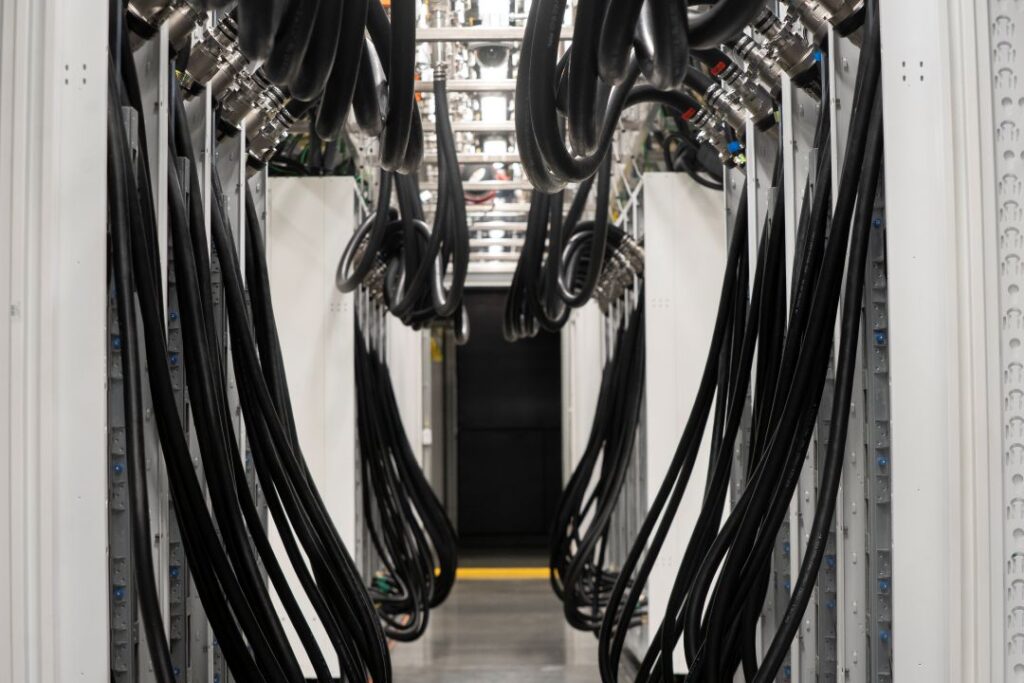
Today, we are unveiling the next Fairwater site of Azure AI datacenters in Atlanta, Georgia. This purpose-built datacenter is connected to our first Fairwater site in Wisconsin, prior generations of AI supercomputers and the broader Azure global datacenter footprint to create the world’s first planet-scale AI superfactory. By packing computing power more densely than ever before, each Fairwater site is built to efficiently meet unprecedented demand for AI compute, push the frontiers of model intelligence and empower every person and organization on the planet to achieve more. To meet this demand, we have reinvented how we design AI datacenters and the systems we run inside of them. Fairwater is a departure from the traditional cloud datacenter model and uses a single flat network that can integrate hundreds of thousands of the latest NVIDIA GB200 and GB300 GPUs into a massive supercomputer. These innovations are a product of decades of experience designing datacenters and networks, as well as learnings from supporting some of the largest AI training jobs on the planet. While the Fairwater datacenter design is well suited for training the next generation of frontier models, it is also built with fungibility in mind. Training has evolved from a single monolithic job into a range of workloads with different requirements (such as pre-training, fine-tuning, reinforcement learning and synthetic data generation). Microsoft has deployed a dedicated AI WAN backbone to integrate each Fairwater site into a broader elastic system that enables dynamic allocation of diverse AI workloads and maximizes GPU utilization of the combined system. Below, we walk through some of the exciting technical innovations that support Fairwater, from the way we build datacenters to the networking within and across the sites. Maximum density of compute Modern AI infrastructure is increasingly constrained by the laws of physics. The speed of light is now a key bottleneck in our ability to tightly integrate accelerators, compute and storage with performant latency. Fairwater is designed to maximize the density of compute to minimize latency within and across racks and maximize system performance. One of the key levers for driving density is improving cooling at scale. AI servers in the Fairwater datacenters are connected to a facility-wide cooling system designed for longevity, with a closed-loop approach that reuses the liquid continuously after the initial fill with no evaporation. The water used in the initial fill is equivalent to what 20 homes consume in a year and is only replaced if water chemistry indicates it is needed (it is designed for 6-plus years), making it extremely efficient and sustainable. Liquid-based cooling also provides much higher heat transfer, enabling us to maximize rack and row-level power (~140kW per rack, 1,360 kW per row) to pack compute as densely as possible inside the datacenter. State-of-the-art cooling also helps us maximize utilization of this dense compute in steady-state operations, enabling large training jobs to run performantly at high scale. After cycling through a system of cold plate paths across the GPU fleet, heat is dissipated by one of the largest chiller plants on the planet. Rack level direct liquid cooling. Another way we are driving compute density is with a two-story datacenter building design. Many AI workloads are very sensitive to latency, which means cable run lengths can meaningfully impact cluster performance. Every GPU in Fairwater is connected to every other GPU, so the two-story datacenter building approach allows for placement of racks in three dimensions to minimize cable lengths, which in turn improves latency, bandwidth, reliability and cost. Two-story networking architecture. High-availability, low-cost power We are pushing the envelope in serving this compute with cost-efficient, reliable power. The Atlanta site was selected with resilient utility power in mind and is capable of achieving 4×9 availability at 3×9 cost. By securing highly available grid power, we can also forgo traditional resiliency approaches for the GPU fleet (such as on-site generation, UPS systems and dual-corded distribution), driving cost savings for customers and faster time-to-market for Microsoft. We have also worked with our industry partners to codevelop power-management solutions to mitigate power oscillations created by large scale jobs, a growing challenge in maintaining grid stability as AI demand scales. This includes a software-driven solution that introduces supplementary workloads during periods of reduced activity, a hardware-driven solution where the GPUs enforce their own power thresholds and an on-site energy storage solution to further mask power fluctuations without utilizing excess power. Cutting-edge accelerators and networking systems Fairwater’s world-class datacenter design is powered by purpose-built servers, cutting-edge AI accelerators and novel networking systems. Each Fairwater datacenter runs a single, coherent cluster of interconnected NVIDIA Blackwell GPUs, with an advanced network architecture that can scale reliably beyond traditional Clos network limits with current-gen switches (hundreds of thousands of GPUs on a single flat network). This required innovation across scale-up networking, scale-out networking and networking protocol. In terms of scale-up, each rack of AI accelerators houses up to 72 NVIDIA Blackwell GPUs, connected via NVLink for ultra-low-latency communication within the rack. Blackwell accelerators provide the highest compute density available today, with support for low-precision number formats like FP4 to increase total FLOPS and enable efficient memory use. Each rack provides 1.8 TB of GPU-to-GPU bandwidth, with over 14 TB of pooled memory available to each GPU. Densely populated GPU racks with app driven networking. These racks then use scale-out networking to create pods and clusters that enable all GPUs to function as a single supercomputer with minimal hop counts. We achieve this with a two-tier, ethernet-based backend network that supports massive cluster sizes with 800 Gbps GPU-to-GPU connectivity. Relying on a broad ethernet ecosystem and SONiC (Software for Open Network in the Cloud – which is our own operating system for our network switches) also helps us avoid vendor lock-in and manage cost, as we can use commodity hardware instead of proprietary solutions. Improvements across packet trimming, packet spray and high-frequency telemetry are core components of our optimized AI network. We are also working to enable deeper control and optimization of network routes. Together, these

tech blog

Bridging the AI divide: How Frontier firms are transforming business

Across every industry, leaders are asking: How can AI be used to fundamentally transform our business? At the forefront are Frontier firms — empowering human ambition and finding AI-first differentiation in everything to maximize their potential and impact on society. These firms are redefining what’s possible and setting the pace for the future. To better understand this transformation, Microsoft commissioned a global study with the International Data Corporation (IDC) of more than 4,000 business leaders responsible for AI decisions. The findings reveal 68% of these companies are using AI today but the real difference lies in how they’re using it. Frontier firms, the ones leading in AI Transformation, report they are achieving returns that are three times higher than slow adopters. What sets Frontier firms apart Their success goes beyond efficiency and productivity at scale, driving growth, expansion and industry leadership in a new AI-powered economy. Based on the IDC study, Microsoft has identified five key lessons learned in becoming a Frontier firm and how organizations can transform their business with AI. #1 EXPANDING AI IMPACT ACROSS EVERY BUSINESS FUNCTION On average Frontier firms are using AI across seven business functions. Over 70% are using AI in customer service, marketing, IT, product development and cybersecurity. These functions benefit from AI’s ability to automate workflows, generate content and detect anomalies in real time. This broad adoption is translating into measurable business impact: Frontier firms report better outcomes at a rate that is 4X greater than slow adopters across brand differentiation (87%), cost efficiency (86%), top-line growth (88%) and customer experience (85%). BlackRock is transforming its investment lifecycle with Microsoft AI integrated into its Aladdin platform. Embedded across 20 apps and used by tens of thousands of users, AI tools help client relationship managers save hours per client by generating personalized briefs and opportunity analyses, while portfolio managers access real-time analytics and research summaries through Aladdin Copilot. The result is faster insights, improved data quality and enhanced risk management; helping BlackRock and its clients gain an advantage while enhancing client service, compliance and portfolio management. #2: UNLOCKING INDUSTRY-SPECIFIC VALUE While many organizations start their AI journey with personal productivity gains like automating tasks and improving efficiency, Frontier firms are moving further, deploying AI for strategic, industry-specific applications. According to the study, 67% are monetizing industry-specific AI use cases to boost revenue. Industries at the forefront of this transformation include financial services, healthcare and manufacturing. Each is finding powerful, practical ways to apply AI to its most complex challenges. In financial services, organizations are strengthening fraud detection, accelerating transaction reconciliation and elevating customer support. In healthcare, it is helping clinicians generate accurate documentation, assist in diagnostics and deliver more personalized care. In manufacturing, AI is driving predictive maintenance, optimizing production schedules and automating quality inspections. Mercedes-Benz is scaling AI across its global production network to advance automotive innovation, stabilize supply chain volatility, simplify production complexity and meet sustainability demands. Its MO360 data platform connects more than 30 car plants worldwide to the Microsoft Cloud for real-time data access, global optimization and analytics. The Digital Factory Chatbot Ecosystem uses a multi-agent system to empower employees with collaborative insights. Paint Shop AI leverages machine learning simulations to diagnose efficiency declines and reduce energy consumption of the buildings and machines — including 20% energy savings in the Rastatt paint shop — and NVIDIA Omniverse on Azure powers digital twins for agile planning and continuous improvement. #3: BUILDING CUSTOM AI SOLUTIONS FOR COMPETITIVE ADVANTAGE Today, 58% of Frontier firms are using custom AI solutions. Custom AI solutions allow businesses to embed proprietary knowledge, tone and compliance into every interaction. They can be fine-tuned on proprietary data or industry-specific knowledge, enabling higher accuracy in predictions or content generation and better alignment with business goals and compliance needs. Within the next 24 months, 77% of Frontier firms plan to use custom AI solutions. This reflects a growing trend that AI leaders are layering in deeper strategic integrations of AI across their business. As customers seek to use AI more to shop and search for products, luxury lifestyle company Ralph Lauren developed a personal, frictionless, inspirational and accessible solution to blend fashion with cutting-edge AI. Working with Microsoft, Ralph Lauren developed Ask Ralph: an AI-powered conversational tool providing styling tips and outfit recommendations from across the Polo Ralph Lauren brand. Powered by Azure OpenAI, the AI tool uses a natural language search engine to adapt dynamically to specific language inputs and interpret user intent to improve accuracy. It supports complex queries with exploratory or nuanced information needs with contextual understanding; and can discern tone, satisfaction and intent to refine recommendations. The tool also picks up on cues like location-based insights or event-driven needs. With Ask Ralph, customers can now reimagine how they shop online by putting the brand’s unique and iconic take on style right into their own hands. #4: AGENTIC AI: THE NEW DIFFERENTIATOR FOR BUSINESS LEADERS Agentic AI — systems that can reason, plan and act with human guidance — is fast becoming the next defining capability of Frontier organizations. In the next two years, IDC estimates the number of companies using agentic AI will triple. Leaders today face a familiar challenge — teams are operating at full capacity, yet the demand for innovation and impact continues to grow. That’s where AI agents come in. In finance, they can surface real-time insights, provide policy guidance, review deal documents and assist in sourcing suppliers. In sales, agents are becoming always-on teammates — building pipelines, unifying insights across CRM systems, meetings, emails and the web and helping sellers qualify leads and draft personalized outreach. In customer service, AI agents can manage cases, maintain knowledge accuracy and interpret customer intent. Dow is using agents to automate the shipping invoice analysis process and streamline its global supply chain to unlock new efficiencies and value. Receiving more than 100,000 shipping invoices via PDF each year, Dow built an autonomous agent in Copilot Studio to scan for billing inaccuracies and surface them in a dashboard for employee review. Using Freight Agent — a

tech blog

Accelerate Telecom with Dell PowerEdge R670 with Intel ®

Boost telecom performance 3x with Dell PowerEdge R670 and Intel® Xeon® 6 processors—build tomorrow’s networks today.   ​  ​Boost telecom performance 3x with Dell PowerEdge R670 and Intel® Xeon® 6 processors—build tomorrow’s networks today. Announcement Blog | Dell

tech blog

The Skunkworks Experiment

How a one-off VR experiment at Cream Productions evolved into an AI-powered creative engine, fueled by Dell and NVIDIA innovation.   ​  ​How a one-off VR experiment at Cream Productions evolved into an AI-powered creative engine, fueled by Dell and NVIDIA innovation. Dell Pro Max Blog | Dell

tech blog

Why PowerProtect Is the #1 Choice for Cyber Resilience

Dell PowerProtect delivers AI-driven cyber resilience with proven scale and efficiency to secure, detect, and recover from threats   ​  ​Dell PowerProtect delivers AI-driven cyber resilience with proven scale and efficiency to secure, detect, and recover from threats Cyber Resilience Blog | Dell

Scroll to Top