INITIALIZING
tech blog

ITMAITY is Now MSME & West Bengal Trade Registered – Building Trust Through Excellence

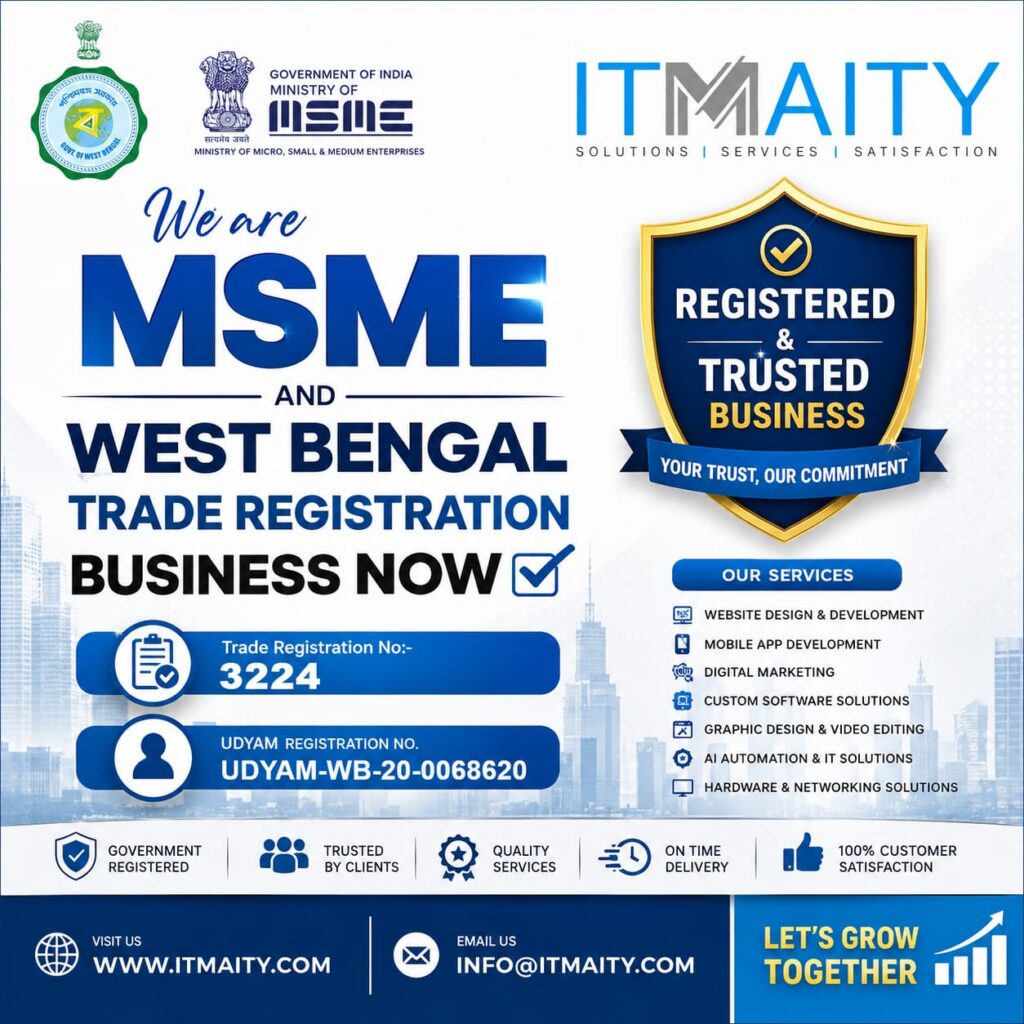
At ITMAITY, every milestone reflects our commitment to delivering reliable, innovative, and customer-centric technology solutions. We are proud to announce that ITMAITY is officially registered under the Ministry of Micro, Small & Medium Enterprises (MSME), Government of India, and holds West Bengal Trade Registration, reinforcing our dedication to transparency, compliance, and business excellence. This achievement is more than a certification—it is a promise to our clients that they are partnering with a legally recognized, trusted, and growth-oriented technology company. Why This Matters for Our Clients Choosing a registered business provides confidence, accountability, and long-term reliability. With our official registrations, clients can expect: At ITMAITY, your trust remains our greatest achievement, and we strive to exceed expectations with every project we undertake. Our Registration Details Trade Registration No.: 3224 UDYAM Registration No.: UDYAM-WB-20-0068620 These registrations demonstrate our commitment to operating with professionalism, credibility, and adherence to industry standards. Our Services ITMAITY offers a complete range of digital and IT solutions to help businesses establish, grow, and succeed in today’s competitive market. 🌐 Website Design & Development Professional, responsive, and SEO-friendly websites designed to strengthen your online presence. 📱 Mobile App Development Custom Android and iOS applications built to enhance customer engagement and streamline operations. 💻 Custom Software Solutions Scalable software tailored to automate business processes and improve efficiency. 📢 Digital Marketing Results-driven SEO, social media marketing, Google Ads, and branding strategies to accelerate business growth. 🎨 Graphic Design & Video Editing Creative branding solutions, marketing creatives, promotional videos, and visual content that leave a lasting impression. 🤖 AI Automation & IT Solutions Intelligent automation, workflow optimization, and modern technology solutions that improve productivity. 🖥️ Hardware & Networking Solutions Reliable IT infrastructure, networking, installation, maintenance, and technical support for businesses of all sizes. Why Choose ITMAITY? When you partner with ITMAITY, you receive more than just IT services—you gain a technology partner committed to your success. Let’s Build Something Great Together Whether you’re a startup, entrepreneur, educational institution, or established enterprise, ITMAITY is here to transform your ideas into powerful digital solutions. Together, let’s innovate, grow, and build a smarter future with technology. 📞 Contact ITMAITY 🌐 Website: www.itmaity.com 📧 Email: info@itmaity.com 📱 Phone: +91 87590 27112 ITMAITY – Solutions | Services | Satisfaction Your Trust, Our Commitment. Let’s Grow Together.

business

Celebrate the Divine Spirit of Subha Rath Yatra with ITMAITY

As the sacred festival of Subha Rath Yatra fills hearts with devotion, faith, and positivity, ITMAITY extends its warmest wishes to you and your family. May the blessings of Lord Jagannath bring peace, prosperity, happiness, and good health into your life. This auspicious occasion reminds us that every journey becomes meaningful when guided by faith, unity, and kindness. Just as Lord Jagannath’s magnificent chariot inspires millions to move forward with hope and devotion, we at ITMAITY remain committed to helping businesses progress with innovative digital solutions and reliable technology services. Our Services At ITMAITY, we empower businesses with comprehensive IT solutions, including: Our goal is to help organizations embrace digital transformation through innovative, scalable, and customer-focused technology solutions. A Festival of Faith and New Beginnings Rath Yatra symbolizes the journey toward success, positivity, and spiritual growth. May this sacred celebration inspire fresh opportunities, stronger relationships, and continued achievements in every aspect of your life. Let us walk together on the path of Devotion, Unity, and Happiness. Jai Jagannath! From the entire ITMAITY family, we wish you a blessed and joyous Subha Rath Yatra. May Lord Jagannath shower his divine blessings upon you and your loved ones today and always. Contact ITMAITY 🌐 Website: www.itmaity.com📧 Email: info@itmaity.com📞 Phone: +91 87590 27112 Follow ITMAITY on social media for the latest updates, technology insights, and business solutions. Happy Subha Rath Yatra! 🙏🚩

tech blog

Why Dell Technologies is Ranked #1 in Enterprise Storage

Dell is No. 1 in enterprise storage worldwide. But share is the result, not the story. Here is what is actually driving the growth.   ​  ​Dell is No. 1 in enterprise storage worldwide. But share is the result, not the story. Here is what is actually driving the growth. PowerStore Blog | Dell

business, tech blog

VOIP Solutions by ITMAITY: Smarter Calls, Better Business

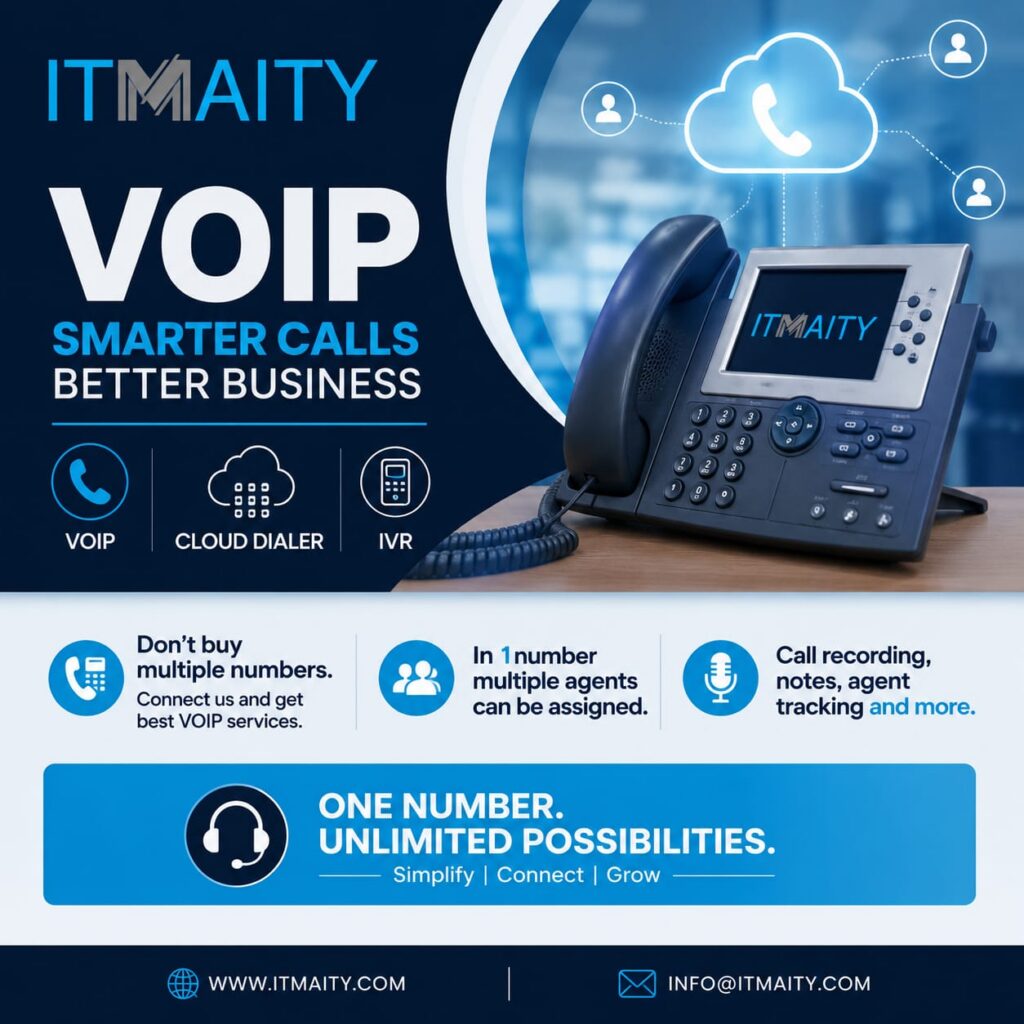
In today’s fast-moving business world, communication is one of the biggest keys to success. Whether you run a small business, call center, clinic, agency, showroom, or service-based company, managing calls professionally can improve customer experience and increase business growth. That’s why ITMAITY brings advanced VOIP, Cloud Dialer, and IVR solutions to make your business communication smarter, faster, and more reliable. With ITMAITY’s VOIP service, you don’t need to buy multiple numbers for different agents or departments. With one number, multiple agents can be assigned, helping your team manage calls smoothly from a single communication system. Why Choose ITMAITY VOIP Services? ITMAITY provides a complete cloud-based calling solution designed for modern businesses. Our VOIP system helps you connect with customers more professionally while saving time and reducing calling management issues. Key Features One Number, Multiple AgentsAssign multiple team members under one business number and manage calls without confusion. Cloud Dialer SupportMake and receive calls through a smart cloud-based dialing system. IVR SetupCreate a professional caller experience with automated call routing like “Press 1 for Sales, Press 2 for Support.” Call RecordingKeep records of customer conversations for quality improvement and training purposes. Agent Tracking & NotesTrack agent performance, call details, and important customer notes easily. Better Customer HandlingNever miss important business calls and manage customer communication in an organized way. Perfect for Every Business ITMAITY VOIP solutions are suitable for: Corporate offices, digital marketing agencies, clinics, hospitals, travel agencies, real estate businesses, sales teams, customer support teams, service centers, e-commerce businesses, and call centers. One Number. Unlimited Possibilities. A professional calling system helps your brand build trust. With ITMAITY’s VOIP and Cloud Dialer solutions, your business can simplify communication, connect better with customers, and grow faster. For reliable VOIP, Cloud Dialer, IVR, and business communication solutions, connect with ITMAITY today. Website: www.itmaity.comEmail: info@itmaity.comContact: +9187590 27112

tech blog

The latest in our company transformation

Amy Coleman, EVP and Chief People Officer, shared the following communication with employees today. When I stepped into this role, I promised to communicate more openly with you and share the “why” behind our decisions. Today we are eliminating around 4,800 roles, about 2.1% of our global workforce, as we focus our people, investments, and energy on the priorities that will keep Microsoft positioned to deliver for customers in a fast-changing industry. The people whose jobs are impacted today are our colleagues and friends. They have made meaningful contributions to Microsoft, and we are deeply grateful for everything they have done. Decisions like these are never easy, and you have my commitment that we are always looking for ways to reduce the need for job eliminations. Whenever possible, our priority is to place people into new roles aligned to the company’s highest priorities and greatest areas of opportunity. Over the past year, we have redeployed more than 4,000 employees into new roles, including another 500 this month. We will also transition four of our gaming studios to operate under new management, with the goal of preserving both their intellectual property and ongoing projects. In addition, more than 30% of eligible employees chose to participate in our recent voluntary retirement program, and we will continue exploring similar approaches in the future. While this doesn’t change the difficulty of today’s news, we will continue to do everything we can to create opportunities for our people, reduce the need for job eliminations where possible, and responsibly support those affected with care and respect. The “why” is this: Our business is changing because the world around it is changing. The way technology is built, deployed, and used is transforming faster than at any point in my time here. Our customers’ needs are shifting, the business models that serve them are shifting, and that means the work itself – what we do, where we focus, and how we’re organized – has to transform too. Companies don’t get to choose whether their industry changes; they only get to choose whether they change with it. That means we will need to adjust resources and roles and shift how we operate so we can have the greatest impact for our customers. I also want to be direct that the roles eliminated today are not being replaced by AI. At the same time, what is true is that AI is changing how work gets done. Some of the tasks we do every day can now be automated, and that means we all need to keep learning, keep building new skills, and keep adapting as the work evolves. Our customers are navigating this same shift, and they’re counting on us to help them through it. We can’t do that well unless we’re doing it ourselves. This comes down to two commitments: making the decisions needed to drive differentiated customer value, and supporting the people affected by them. First, we will make the hard changes required to build differentiated products and services that deliver differentiated customer value. We are aligning our investment, people, and energy to our business priorities. Today’s changes mostly fall within our Commercial and XBOX organizations. In our Microsoft Commercial Business, they build on last week’s Frontier Company announcement, reshaping how we work and embedding our engineering experts alongside customers so we can help them accelerate their technology deployments. In XBOX, we are restructuring to position the business for long-term success. Engineering teams across the company will also evolve their structure and priorities to meet customer needs and innovate for the future. Second, we will do this thoughtfully.  As mentioned above, we are working on alternative solutions to job eliminations, and beyond this, we will continue to invest in equipping employees with new skills, including in AI. For those who are impacted, we provide financial support and resources to help them take their next step. I know many of you want to help those who are leaving but aren’t sure how. Reach out and check in on your colleagues. Use your network to bring people together, share what makes them exceptional, and help create connections to opportunities that might not happen otherwise. We are still early on this journey, and there will be more changes ahead; other parts of our business will need to make similar changes. Each time, you can hold us to the two commitments. During my time at Microsoft, I’ve seen this company reinvent itself again and again. What makes that possible has always been our people – their resilience, creativity, and willingness to keep learning. Thank you for everything you bring to Microsoft. Amy Read more: Resetting XBOX. The post The latest in our company transformation appeared first on The Official Microsoft Blog. ​Amy Coleman, EVP and Chief People Officer, shared the following communication with employees today. When I stepped into this role, I promised to communicate more openly with you and share the “why” behind our decisions. Today we are eliminating around 4,800 roles, about 2.1% of our global workforce, as we focus our people, investments, and… The post The latest in our company transformation appeared first on The Official Microsoft Blog.  Featured, The Official Microsoft Blog The Official Microsoft Blog

tech blog

Microsoft Frontier Company: AI engineering that amplifies and protects your intelligence

The pace of AI adoption is moving incredibly fast. Customers have moved well beyond experimentation and understand the importance of adopting AI to transform their business. They are now concentrating on delivering measurable business outcomes and demonstrating a return on their AI investments, while ensuring their intelligence is amplified and their IP is protected. Today we are introducing Microsoft Frontier Company, a new operating business focused on delivering Frontier Transformation through AI for our customers around the world. It will provide a unique combination of skills inclusive of deep industry knowledge, change management and continuous improvement experience, and enterprise-grade AI engineering expertise. This goes beyond what has been labeled as Forward Deployed Engineering (FDE) and will be the largest, most capable, outcome-driven engineering organization in the industry. We are making a $2.5B investment in Microsoft Frontier Company, embedding 6,000 industry and engineering experts at customers to co-design, co-innovate, deploy and continuously improve AI systems at scale based on measurable business outcomes. I recently wrote more about my conviction that Intelligence + Trust are the two most important components of any AI solution and how our customers can use different levers to manage cost. Companies need to establish an intelligence platform so their unique IQ — their proprietary data, expertise, workflows and decision-making processes — compounds over time from within, using their choice of models to build AI solutions and workflows. They need a trusted platform that allows them to observe, govern, manage and secure AI solutions across every layer of the technology stack, using FinOps to assess their ROI. Enterprise AI engineering expertise with deep industry knowledge is required to build a system that acts as a continuous loop of improvement between the two platforms to fine tune agentic business processes, ensuring that a customer’s intelligence compounds over time and delivers real business outcomes. This is what Microsoft Frontier Company was built to do: focus on end-to-end Frontier Transformation, enabling customers to amplify their IQ with AI while refining their differentiated value in the markets that they serve. Early results demonstrate meaningful impact: Our engineers and industry experts partnered with LSEG (London Stock Exchange Group) to embed AI into LSEG Workspace, helping finance professionals ask complex questions and get quick answers across structured and unstructured financial content. The solution is underpinned by a foundation that is iteratively refined through client feedback and real-time user testing that accelerates each cycle and steadily improves model quality and scope. From LSEG to Land O’Lakes to Unilever to Novo Nordisk, our differentiated approach is already delivering measurable outcomes on our customers’ Frontier Transformation journeys. To achieve scale, we will work closely with our partner ecosystem to extend this unique value to our customers across all markets and segments globally. We have robust FDE partnerships with our Global SI partners, including Accenture, Capgemini, EY, KPMG, PwC and others. Central to this approach is a principle that is non-negotiable: a customer’s IQ is protected. Their data, their IP, their competitive advantage — none of it is used to train models in ways that commoditize what differentiates them in their industry. Satya put it clearly recently: there is no societal permission for an AI future that eats the intelligence of the companies it’s deployed inside. We built Microsoft Frontier Company to make sure that does not happen. We protect that intelligence with a model-diverse, open, heterogeneous AI platform. Customers shouldn’t be locked into a single model any more than they should be locked into a single technology vendor. Microsoft’s platform gives organizations the flexibility to run the right model for each scenario — whether it comes from OpenAI, Anthropic, Microsoft AI, open source or a specialized model tuned for a specific industry — without ceding control to any one of them. To lead this new organization, I have asked Rodrigo Kede Lima to be the President of Microsoft Frontier Company. Rodrigo brings 30 years of industry experience, and for the past six at Microsoft has led enterprise-wide transformations as a sales leader in the Americas and Asia. He has been at the forefront of helping customers and partners translate technology shifts into business outcomes, and understanding how platform innovation, engineering and partner ecosystem collaboration come together to drive growth. I am excited about all the things that Microsoft Frontier Company will do for our customers to realize the gains of Frontier Transformation. At the end of the day, it comes down to Intelligence + Trust and empowering our customers to achieve meaningful outcomes and a return on their investments. Learn more at www.microsoft.com/en-us/frontier-company. Judson Althoff is the chief executive officer of Microsoft Commercial Business. He is responsible for the product strategy, sales, services, support, marketing, operations and revenue growth of the company’s commercial business, which operates in more than 120 regional and national subsidiaries globally. The post Microsoft Frontier Company: AI engineering that amplifies and protects your intelligence appeared first on The Official Microsoft Blog. ​The pace of AI adoption is moving incredibly fast. Customers have moved well beyond experimentation and understand the importance of adopting AI to transform their business. They are now concentrating on delivering measurable business outcomes and demonstrating a return on their AI investments, while ensuring their intelligence is amplified and their IP is protected. Today… The post Microsoft Frontier Company: AI engineering that amplifies and protects your intelligence appeared first on The Official Microsoft Blog.  Featured, The Official Microsoft Blog, AI, Frontier Transformation, Microsoft Frontier Company The Official Microsoft Blog

tech blog

Why Expensive GPUs Sit Idle

GPU utilization is a data problem before it is a compute problem, and the three forms of data are how you solve it.   ​  ​GPU utilization is a data problem before it is a compute problem, and the three forms of data are how you solve it. AI Data Platform Blog | Dell

tech blog

When Architecture Fights Gravity, Operations Pay the Tax.

Why “unified namespace” is a polite way of pretending data has no mass, and what the three forms of data actually let you move.   ​  ​Why “unified namespace” is a polite way of pretending data has no mass, and what the three forms of data actually let you move. AI Data Platform Blog | Dell

business, tech blog

🔒 One Click Can Cost Your Business: How to Protect Yourself from Phishing Attacks by ITMAITY

In today’s digital world, cybercriminals are becoming smarter every day. A single click on a fake email can compromise sensitive business data, expose customer information, and result in significant financial losses. Phishing attacks remain one of the most common cybersecurity threats—but with awareness and caution, they are preventable. What is a Phishing Attack? A phishing attack is a fraudulent attempt to steal sensitive information such as passwords, banking details, or company data by pretending to be a trusted source. These emails often appear to come from legitimate organizations and encourage users to click malicious links or download infected attachments. How to Stay Protected ✅ Verify the Sender Always check the sender’s email address carefully. Cybercriminals often use addresses that look similar to genuine ones but contain subtle differences. 🔗 Inspect Links Before Clicking Hover over links to preview the destination URL before clicking. If the link looks suspicious or unfamiliar, avoid opening it. 🛡️ Stay Alert Be cautious of emails creating urgency, requesting confidential information, or offering unexpected rewards. When in doubt, verify with the sender through an official communication channel. Why Cybersecurity Matters Every employee plays a vital role in protecting an organization’s digital assets. Building a culture of cybersecurity awareness can significantly reduce the risk of phishing attacks and data breaches. Stay Secure. Stay Smart.Protect your business by staying informed and thinking before you click. Why Choose ITMAITY? At ITMAITY, we help businesses strengthen their digital security through reliable IT solutions, cybersecurity awareness, and technology services tailored to modern business needs. Whether you’re a startup or an established enterprise, our team is committed to helping you build a safer and smarter digital workplace. 📞 Contact Us Company: ITMAITY📧 Email: info@itmaity.com📱 Phone: +91 87590 27112🌐 Website: www.itmaity.com

tech blog

Raiganj Business Summit 2026 – A New Era of Business Networking Begins!

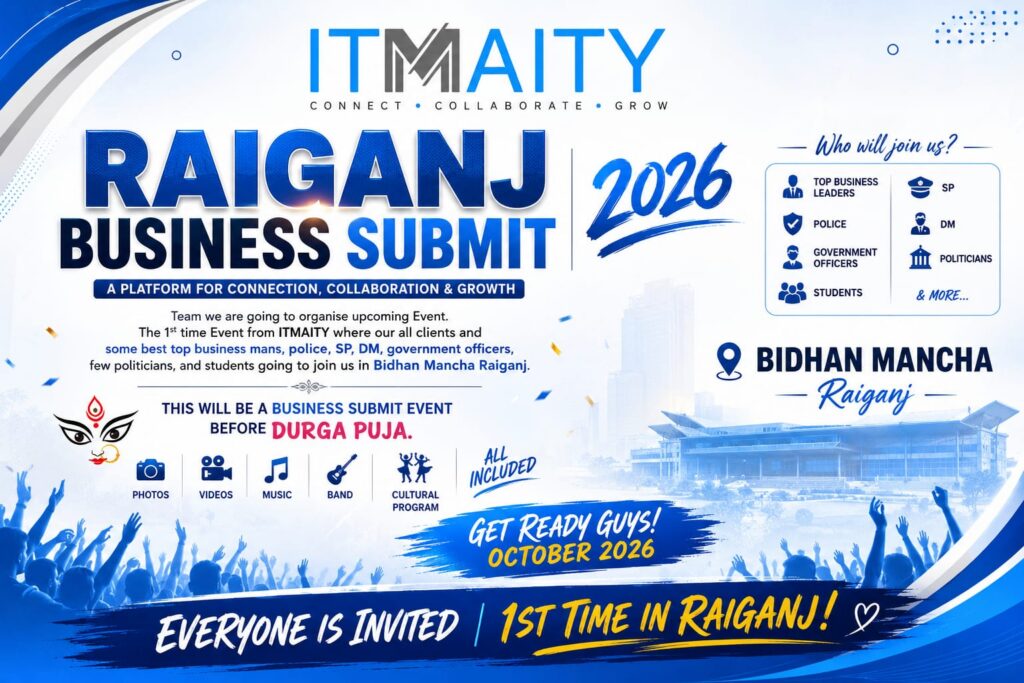
ITMAITY Presents the Raiganj Business Summit 2026 ITMAITY is proud to announce the Raiganj Business Summit 2026, an exclusive networking and collaboration platform designed to bring together influential leaders, entrepreneurs, professionals, and aspiring innovators under one roof. This landmark event will serve as a hub for business growth, strategic partnerships, knowledge sharing, and meaningful connections, making it one of the most anticipated business gatherings in Raiganj. Why Attend? The Raiganj Business Summit 2026 is more than just an event—it’s an opportunity to connect with people who shape industries and communities. Who Will Be Joining? Whether you’re a business owner, startup founder, student, or professional, this summit offers valuable opportunities to learn, network, and grow. Event Highlights Participants can look forward to an exciting and engaging experience featuring: Every aspect of the event has been thoughtfully planned to create an inspiring environment where ideas transform into opportunities. Event Details 📍 Venue: Bidhan Mancha, Raiganj 🗓️ Tentative Schedule: October 2026 (Before Durga Puja) This will be the first-ever business summit of its kind in Raiganj, creating a unique platform for collaboration between businesses, government representatives, educational institutions, and future leaders. Why ITMAITY? At ITMAITY, we believe that strong communities are built through collaboration, innovation, and meaningful relationships. The Raiganj Business Summit reflects our commitment to empowering businesses and creating opportunities that drive regional growth. Our mission is simple: Connect • Collaborate • Grow Be a Part of History Don’t miss the opportunity to become part of Raiganj’s biggest business networking event. Whether you’re looking to expand your professional network, discover new business opportunities, or gain industry insights, the Raiganj Business Summit 2026 is the place to be. Everyone is Invited! Let’s build stronger connections, inspire innovation, and shape the future of business together. Contact ITMAITY 📧 Email: info@itmaity.com 📞 Phone: +91 87590 27112 We look forward to welcoming you to Raiganj Business Summit 2026—where ideas meet opportunities and partnerships create success.

tech blog

Stop Scam Agencies – Choose a Trusted Digital & IT Partner

In today’s fast-paced digital world, choosing the right technology partner is more important than ever. Unfortunately, many businesses fall victim to unreliable service providers who make big promises but fail to deliver. At ITMAITY, we believe in trust, transparency, and long-term partnerships. As a registered and professional Digital & IT solutions company, we help businesses build, grow, and succeed with reliable technology solutions tailored to their needs. Why Choose ITMAITY? ✅ Registered & Certified CompanyWork with a genuine and trusted IT partner committed to quality and reliability. ✅ Experienced Professional TeamOur skilled experts bring years of experience across multiple technologies and industries. ✅ Industry-Focused SolutionsCustomized digital solutions designed to solve real business challenges and drive growth. ✅ Quality, Transparency & SupportFrom consultation to project delivery and beyond, we maintain complete transparency and provide dedicated support. Our Services Whether you’re a startup, small business, or established enterprise, ITMAITY is committed to delivering innovative, scalable, and cost-effective digital solutions that help your business stay ahead of the competition. Let’s Work Together Your business deserves a technology partner you can trust—not empty promises. Choose Trust. Choose ITMAITY. 📞 Contact Us Company: ITMAITYPhone: +91 87590 27112Email: info@itmaity.comWebsite: https://itmaity.com ITMAITY – Your Trusted Digital & IT Partner. 🚀

tech blog

Inside Microsoft’s two-decade push to cut water intensity while scaling for growth

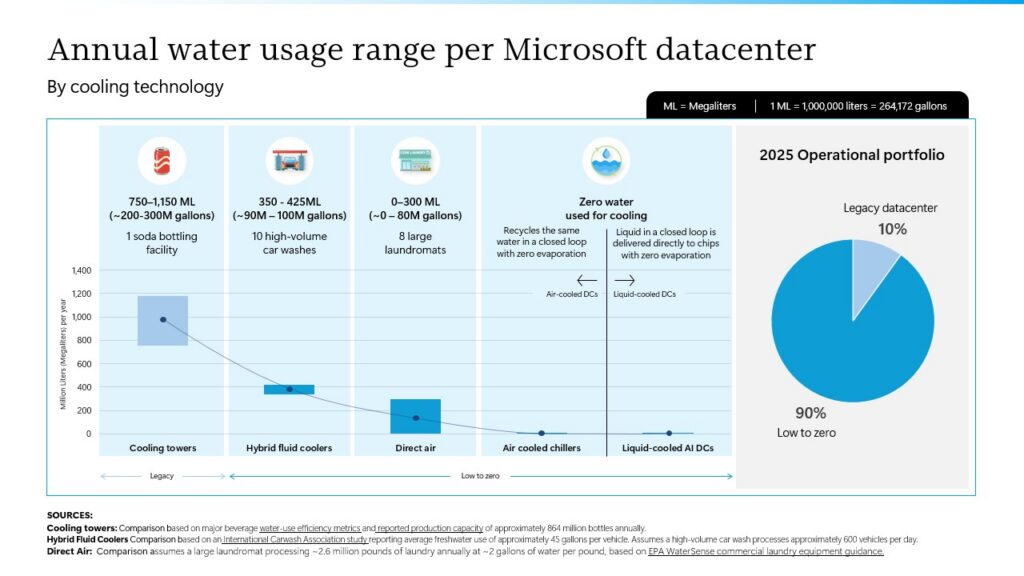
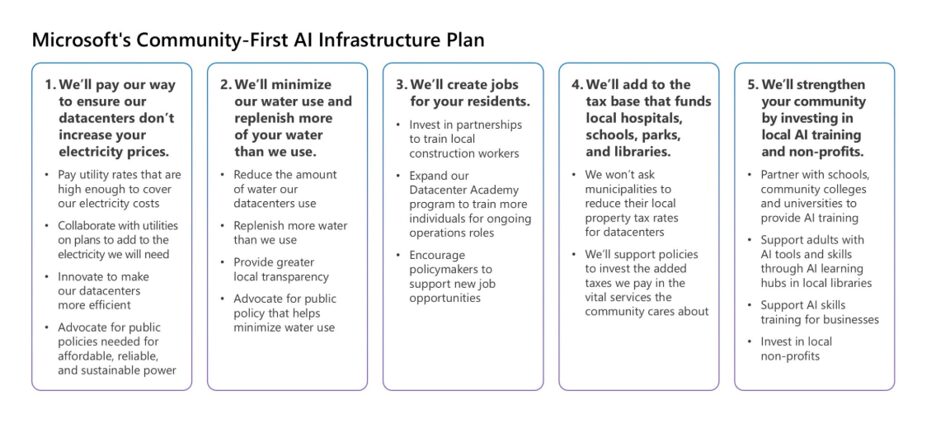
As demand for cloud and AI services continues to grow, datacenters are becoming more essential than ever. Communities also want to better understand how this infrastructure affects local resources, particularly water. At Microsoft, water stewardship has been a priority since our first datacenter builds in the early 2000s and remains a core part of our strategy today and into the future. It underpins both our Community-First AI Infrastructure initiative and our company-wide commitment to become water positive by 2030, meaning we will replenish more water than we withdraw. We are pairing our progress with continued transparency so people can understand not only how much water we use, but also how we are working to reduce that use over time. Through continuous innovation and advancements in cooling technologies, we have improved our water use effectiveness (WUE), measured in liters per kilowatt-hour (L/kWh), by nearly 90% since our first generation of datacenters in the early 2000s. Our average WUE has decreased from 2.3 L/kWh to 0.27 L/kWh in 2025, reflecting decades of innovation and our ongoing commitment to reducing the water intensity of our datacenters while meeting the growing demand for cloud and AI services. Across our entire owned fleet of datacenters, we are committed as a company to a 40 percent improvement in datacenter water-use intensity by 2030. As of 2025, we have reduced our water-use intensity by 25 percent, putting us well over halfway toward our goal. This strong progress reflects the impact of our continued investments in water-efficient cooling technologies, operational improvements and responsible water management practices.* In FY25, Microsoft reached an important milestone toward its 2030 water positive commitment, replenishing more water than it withdrew across its global operations for the year. We have made this progress by decoupling datacenter growth from water use through resilient, responsible water stewardship practices and the deployment of increasingly efficient cooling technologies — demonstrating that digital growth and sustainable water management can advance together. We are committed to building on this progress and working toward sustaining water positive performance over time as we continue advancing toward our 2030 goal. Early water stewardship by design Beginning with some of our earliest datacenter designs, we prioritized water efficiency while minimizing impacts on energy use through the deployment of high-efficiency economizing chillers operating at elevated water temperatures. As early as 2008, we adopted direct air cooling with evaporative assist as the primary cooling approach across our datacenter fleet. This design uses significantly less electricity and up to 90% less water than traditional water-based cooling systems by relying on water only when outside temperatures exceed 85°F (29.4°C). In parts of Northern Europe, no water is required for cooling throughout the year, while in other cooler regions like Dublin and Amsterdam, water is used less than 5% of the time. In more temperate climates like Virginia, water is typically required only 10% of the year, while in the hottest climates like Phoenix, water use may increase to as much as 40% of the year. As a result, approximately 90% of our 2025 owned fleet operates using highly efficient, low- to zero-water cooling systems. YouTube Video Click here to load media While the majority of our existing datacenters are already highly water efficient, we did not stop there. In 2024, Microsoft introduced a new datacenter design optimized for AI workloads that consumes zero water for cooling during operations, further reinforcing our commitment to water stewardship by design. This chip-level cooling solution delivers precise zonal temperature control without water evaporation by recirculating water through a closed-loop, direct-to-chip cooling system. As our datacenter fleet continues to expand, the addition of these zero-water designs will further reduce Microsoft’s water use intensity over time. Datacenter cooling methods, explained: Cooling towers: Traditional systems that remove heat by evaporating water year-round. Hybrid fluid coolers: Evaporates water for cooling during hot summer conditions and switches to dry mode when ambient temperatures cool down. Direct air: Uses outside air for cooling, with little to no water use. Water is used only when outside air is above 85°F. Air cooled chillers: Uses mechanical refrigeration and outside air to remove heat from closed coolant loops with zero water evaporation. Liquid-cooled AI DCs: Uses closed-loop, direct-to-chip cooling to provide precise chip-level temperature control, removing heat efficiently with zero water evaporation. Modernizing cooling in existing datacenters with smarter controls Design innovation is only part of the story. We are also improving the efficiency of existing facilities that use water through a continuous focus on optimizing temperature and humidity setpoints, enabling more precise environmental control and eliminating overcooling. In addition, we regularly audit water use and compare actuals against design expectations using real-time weather data and operational analytics. This helps ensure our datacenters are performing as intended and enables us to quickly identify and address any unexpected water use. These efforts, combined with ongoing hardware and operational improvements, are all aimed at using as little water as possible. Specifically in our Phoenix, Arizona, datacenters, implementation of these advancements led to a 23% year-over-year improvement in WUE in FY25 alone. We are now deploying these advancements across our direct-evaporatively cooled datacenters globally. Operational improvements like these are one reason Microsoft has been able to report significant long-term reductions in water intensity across datacenter generations. They also point to the next phase of our work: expanding the use of recycled and alternative water sources wherever possible. Leveraging recycled, reused and non-potable water In addition to driving efficiency, we also prioritize using recycled, reused or non-potable water wherever possible in our operations. We have expanded the use of these non-potable water sources in some of our most water-intensive regions, helping reduce demand on freshwater supplies. For example, in Quincy, Washington, Singapore and San Antonio, Texas, three of our key locations for advancing water stewardship, we leverage 74%, 99% and 79% recycled, reused or non-potable water sources, respectively. Rainwater harvesting systems are now operational at select datacenters in the Netherlands, Sweden and Ireland, with additional installations planned in Canada, the United Kingdom, Finland, Italy,

tech blog

Transforming Education with ITMAITY School Management Software

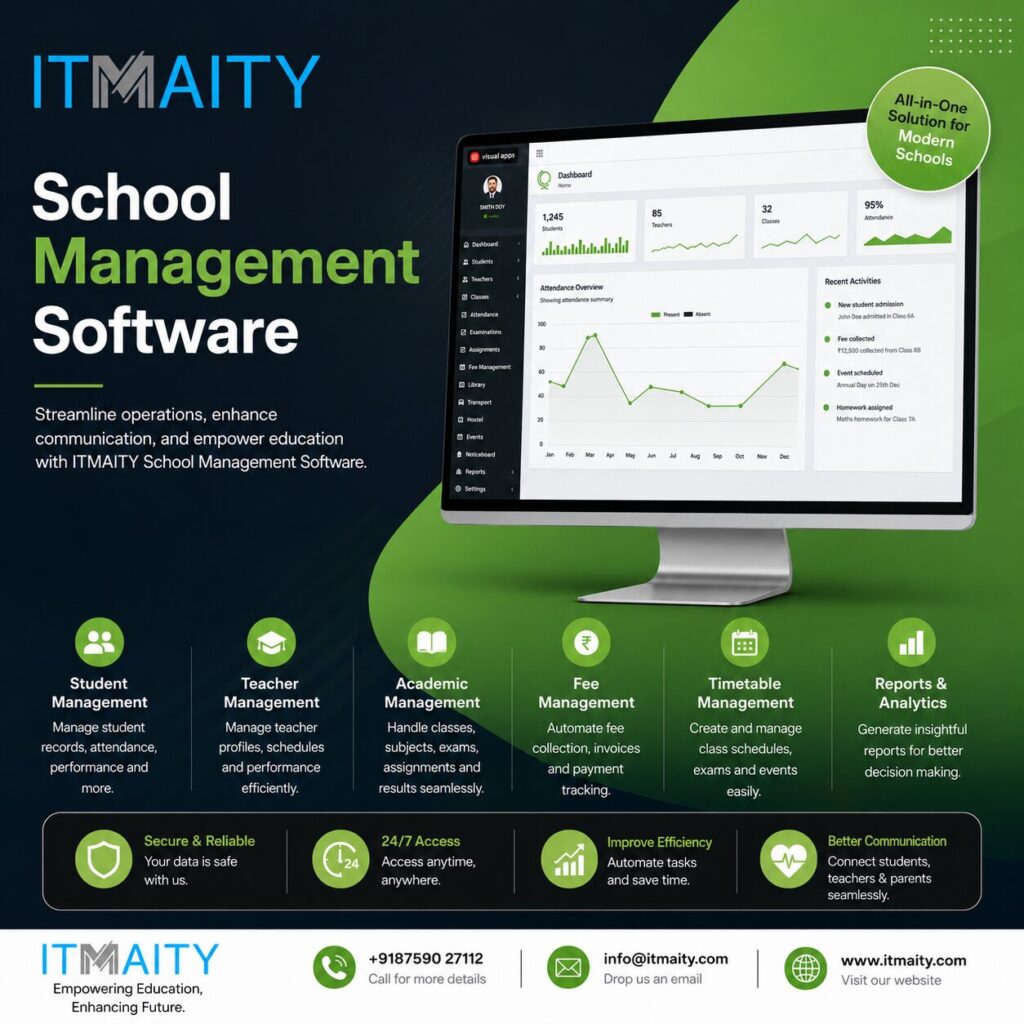
Smart School Management for Modern Educational Institutions In today’s fast-paced educational environment, schools need efficient, reliable, and technology-driven solutions to manage daily operations. ITMAITY School Management Software is a comprehensive platform designed to simplify administrative tasks, improve communication, and enhance the overall learning experience for students, teachers, and parents. Whether you’re managing admissions, attendance, examinations, fees, or academic performance, ITMAITY provides an all-in-one solution to streamline your school’s operations and improve productivity. Why Choose ITMAITY School Management Software? Educational institutions face numerous challenges in handling large volumes of data and coordinating activities across multiple departments. ITMAITY’s School Management Software addresses these challenges with an intuitive and feature-rich platform. Key Features 📚 Student Management Maintain detailed student records, monitor attendance, track academic performance, and manage student information efficiently from a centralized dashboard. 👨‍🏫 Teacher Management Organize teacher profiles, schedules, workload distribution, attendance, and performance tracking with ease. 🎓 Academic Management Manage classes, subjects, assignments, examinations, grading systems, and academic reports seamlessly. 💰 Fee Management Automate fee collection, generate invoices, track payments, and reduce administrative workload with integrated financial management tools. 📅 Timetable Management Create and manage class schedules, teacher allocations, examination routines, and event calendars effortlessly. 📊 Reports & Analytics Access detailed reports and real-time analytics to make informed decisions and improve institutional performance. Benefits of ITMAITY School Management Software ✅ Secure & Reliable Your school’s sensitive data is protected with advanced security measures and secure cloud-based infrastructure. ✅ 24/7 Accessibility Access school information anytime, anywhere through a user-friendly web platform. ✅ Improved Efficiency Automate repetitive administrative tasks, reduce paperwork, and save valuable time for educators and administrators. ✅ Better Communication Enhance collaboration between teachers, students, parents, and school management through centralized communication tools. Empowering Education, Enhancing Futures At ITMAITY, we believe technology should simplify education management while improving learning outcomes. Our School Management Software is designed to help educational institutions operate more efficiently, allowing educators to focus on what matters most—student success. Whether you run a school, college, coaching center, or educational institution, ITMAITY provides the tools you need to manage operations effectively and scale with confidence. Contact ITMAITY 📞 Phone: +91 87590 27112📧 Email: info@itmaity.com🌐 Website: https://itmaity.com ITMAITY – Empowering Education, Enhancing Futures.

tech blog

Rethinking cloud operations with agentic observability

Cloud operations are entering a new era as AI-driven and autonomous agents become a larger part of modern software systems. As software becomes increasingly agentic, the challenge is no longer just managing greater scale and complexity. Operators must also contend with systems that evolve faster, act more autonomously and interact across an expanding network of dependencies. As applications, models, APIs and infrastructure become increasingly interconnected, their behavior is harder to understand end to end. Systems no longer fail in isolation. They fail through interactions across dependencies, services and environments that are constantly changing in real time. To help organizations operate effectively in these increasingly dynamic environments, today we’re announcing the general availability of the Azure Copilot Observability Agent. Built on Microsoft Azure Monitor, it correlates signals across agents, applications, infrastructure and services to provide the context needed to operate confidently in this new environment. Observability becomes foundational in an agentic world In a recent survey of 250 IT decision-makers, Microsoft and Material found that 84% of organizations report increased cloud complexity, with 69% saying it is outpacing their current operating model. The impact is most acute across security, cost management and performance, and it extends across the entire operations lifecycle. As the pace and scale of change accelerate, no individual or team can realistically maintain the full context required to diagnose and resolve issues quickly enough. This is driving a shift toward agentic operations, where intelligence augments how systems are understood and managed. Observability is foundational to this shift. It provides the real-time understanding of system behavior that agents depend on to reason, adapt and act. Without a connected view across signals, even the most advanced agents lack the context required to operate reliably. From signals to resolution with the Observability Agent We designed the Observability Agent to help operators move more quickly from detection to understanding. It connects logs, metrics, traces, topology and operational context across environments, reducing the time it takes to identify the root cause of an issue. As telemetry spreads across systems, operators are often forced to piece together context across multiple tools. The Observability Agent addresses this fragmentation by reasoning across signals in real time and unifying that context into a single operational view. These agentic capabilities are integrated directly into existing workflows, helping teams move from investigation to resolution faster with clear, actionable insight. We’re already seeing customers use the Observability Agent to reduce manual effort, accelerate incident resolution and improve operational clarity: “The biggest value is speed! The [Azure Copilot] Observability Agent helps us resolve incidents faster and reduce operational overhead by turning logs, metrics and traces into plain English insights. These agents run deep investigations and provide remediation recommendations almost immediately, compared to hours or even days previously. Since adopting these capabilities, we’ve reclaimed an estimated 250 engineering hours monthly that are now redirected toward supporting new applications and features. We can use natural language to detect, diagnose and remediate issues faster than ever before.” — Narmada Krishnaswamy, Head of KPMG Audit Application Support and Operations “Azure Copilot Observability Agent helped us move from manual incident hunting to faster, AI-guided investigations. For PolicyVault, it pulls together the telemetry from our service, correlates it with Azure resource health and gives us actionable next steps based on the investigation. That means we’re not just seeing what broke; we’re getting a much clearer idea of why it happened and what to do about it, which saves us a lot of time during incidents.” — Vladimir Gusarov, Founder & CEO, PolicyVault “Azure Copilot’s Observability Agent helps us move faster from signal to insight. By bringing together our telemetry and guiding us toward likely root causes, it reduces the time and effort needed to investigate incidents and keeps our teams focused on what matters most.” — Theus Hossmann, Chief Technology Officer at Ontinue Beyond improving incident response, this shift reflects a new approach to cloud operations, where systems can continuously reason across signals and act on that understanding. Check out our Tech Community blog post to learn more about the Azure Copilot Observability Agent. From observability to agentic operations across the cloud lifecycle Observability is part of a broader shift to agentic operations. As systems become more autonomous, operations expand from understanding what is happening in production to continuously improving how those systems behave over time. In an agentic model, this forms a lifecycle. Systems generate signals, agents interpret those signals, take action and learn from outcomes. Over time, this creates a feedback loop where each operational cycle improves the next, increasing system resilience and efficiency. This shift requires more than better visibility. It requires a coordinated approach across the lifecycle, from observability and diagnosis to optimization and remediation where insight and action are tightly connected. As agents take on a greater role in that lifecycle, governance becomes central to how systems are trusted and controlled. Policy, auditability and guardrails ensure that actions taken by agents align with organizational intent and operate within defined boundaries. Human oversight remains essential, not as a bottleneck, but as a mechanism for building confidence and ensuring reliability as automation scales. This is where Azure is uniquely positioned. By bringing together observability, automation and governance within a connected platform, Azure enables organizations to move from isolated tools to an integrated operational model that spans the full lifecycle. Azure Copilot Observability Agent plays a key role in this model by grounding agentic systems in real-time operational context. As organizations build and deploy more agents, this foundation becomes critical for ensuring those systems operate effectively and responsibly. Cloud operations are shifting from reactive management to a continuous, agent-driven lifecycle of learning, adaptation and control. This vision of agentic cloud operations is already taking shape across Azure. Read our companion Azure Blog post for more details. Brendan Burns is a co-founder of the Kubernetes open source project and corporate vice president for Azure cloud-native open source and the Azure management platform including Azure Arc. He is also the author and co-author of several books

tech blog

Powering the next wave of AI: Expanding capacity with our new datacenter in Pecos

Today, Microsoft is announcing one of the largest single capacity additions in our history. In Pecos, Texas, we will build a new datacenter campus, expanding our global datacenter capacity by approximately 2 gigawatts (GW) to meet strong and sustained customer demand for AI and cloud services across industries and regions. Beyond the technology, this is a major investment in West Texas. We expect to support over 6,000 construction jobs at peak build-out and to create hundreds of permanent operational jobs that will add a new industry that supports the local economy when the new datacenter campus is operational. This multibillion-dollar datacenter campus investment over the next five to seven years reflects both the immediate needs we are seeing today and the future trajectory of AI and advanced compute, where reliable infrastructure at scale is essential to unlocking the next generation of innovation. This expansion is grounded in a simple principle: we build where our customers need us, and we build for the long term. We have a track record of doing exactly that in Texas. In the San Antonio region, where we have operated datacenters for nearly a decade, our investment has generated billions of dollars in local economic activity and supported thousands of local jobs. We are committed to delivering the same lasting value in Pecos. Meeting customer demand with reliable infrastructure Customer demand for AI and cloud services continues to grow rapidly, from startups building new applications to governments, healthcare providers and educational institutions modernizing critical systems. Meeting this demand requires not only more datacenter capacity, but capacity that is predictable, resilient and able to scale quickly. The datacenter campus in Pecos enables us to deliver on that need. By pairing new datacenter infrastructure with dedicated energy supply located onsite, we can bring capacity online at the pace our customers require while maintaining operational reliability. Critically, the energy infrastructure required to power this datacenter is being funded by Microsoft. We are paying for the new generation and supporting infrastructure needed to serve our own operations. The capacity we bring online in Pecos is built to meet our demand, ensuring that our growth strengthens, rather than strains, the energy resources the community relies on. Putting Community First in West Texas While meeting customer demand is critical, how we grow is equally important. At Microsoft, our Community First approach guides us where we build, own and operate our datacenters, including our new datacenter campus in Pecos. This work begins with a simple commitment: we show up as a lasting partner, not just a builder of infrastructure. As shared in our letter to the community in Pecos and Reeves County, we are approaching this project as a new neighbor, with a focus on partnership, transparency and listening. We recognize that earning trust takes time, and we are committed to ongoing engagement with local residents, leaders and organizations as this project moves forward. The region’s elected leadership has welcomed the investment. Reeves County Judge Leo Hung, the county’s top elected official, said: “We are excited to welcome Microsoft to Pecos. This investment reflects the strength of our region and its ability to support innovation at a global scale. It will create new opportunities for local businesses, support workforce development and reinforce Pecos as a place where forward-looking companies can grow and thrive.” Our Community First approach in this region focuses on three priorities: 1. Listening and engaging early We engage early and often through community meetings, local partnerships and ongoing communication across the life of the project, which gives residents multiple ways to ask questions and share feedback, just as we have in other Texas communities. 2. Creating local economic opportunity This project is built to drive lasting regional growth. As well as supporting thousands of construction jobs, the hundreds of permanent operational roles will add a new industry to the local economy. We will also invest in workforce development and small-business support. We are focused on ensuring that local residents are prepared to take advantage of the opportunities created by the AI economy. This is part of a sustained commitment to the region, building on more than a decade of experience in Texas, including our operations in San Antonio: A snapshot of Microsoft’s long-term impact in San Antonio, the kind of partnership we are bringing to Pecos. Near San Antonio, where we have operated for nearly a decade, our Datacenter Academy partners with local colleges to prepare students for datacenter careers, including a $545,000 investment that has already reached more than 450 students. Statewide, workforce programs like TechSpark have helped create more than 1,100 jobs and engaged 20,000 Texans in digital skilling. We will bring the same model of local hiring, training and small-business support to West Texas. 3. Partnering for lasting community impact Our investment reaches well beyond the datacenter, into education, digital inclusion and nonprofit partnerships. In fiscal year 2024, Microsoft and its employees contributed $11 million in cash and $103.3 million in donated software and cloud technology to more than 10,000 Texas nonprofits, alongside 42,000+ employee volunteer hours. In Pecos, we will direct that same commitment toward the priorities that matter most to West Texas residents. Advancing sustainability through innovation As we expand our datacenter footprint, we remain equally committed to building and operating our infrastructure in ways that reduce environmental impact. Energy and emissions This includes improving energy efficiency across our infrastructure, from compute to hardware, and building on the 4.7 GW of renewable electricity we have already contracted for our electricity use in Texas, advancing carbon-free electricity through renewable generation and other technologies. This investment is intentionally designed with flexibility in mind, allowing Microsoft to adjust capacity over time as demand evolves. At launch, the datacenter campus will operate with a co-located natural gas power facility, an arrangement known as “behind the meter.” This serves the campus directly and independently of the public grid, so this demand does not take from the current grid. The plant’s design will integrate state-of-the-art air emissions controls, such as

tech blog

Empowering Education Through Reliable LAN & Network Infrastructure

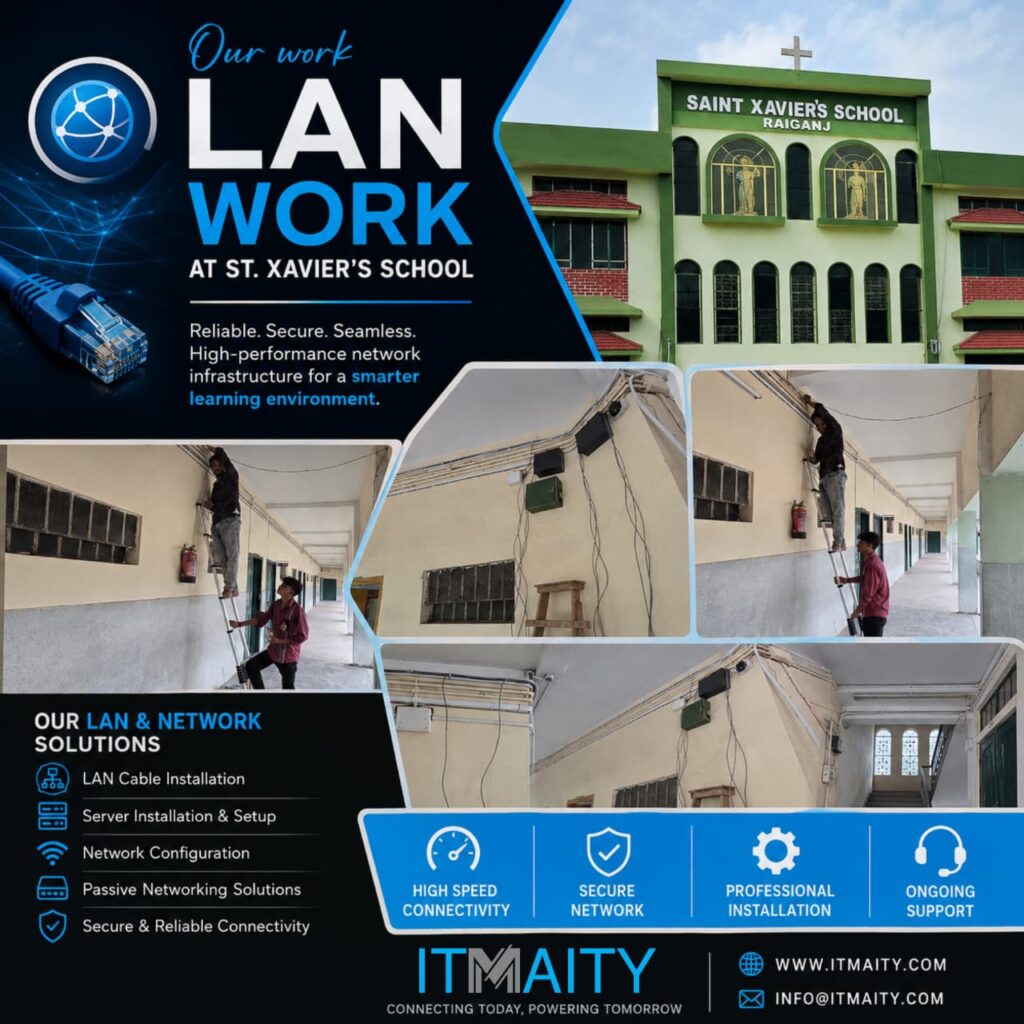
A Successful Networking Project by ITMAITY Building a Smarter Learning Environment At ITMAITY, we believe that a strong digital infrastructure is the foundation of modern education. We are proud to showcase our successful LAN and Network Installation Project at St. Xavier’s School, Raiganj, where our team delivered a secure, high-speed, and reliable networking solution to support the institution’s growing technological needs. Project Overview Educational institutions depend heavily on uninterrupted connectivity for administration, online learning, digital classrooms, examinations, and communication. To meet these requirements, ITMAITY designed and implemented a comprehensive networking solution that ensures smooth and efficient operations across the campus. Services Delivered ✅ LAN Cable Installation✅ Server Installation & Setup✅ Network Configuration✅ Passive Networking Solutions✅ Secure & Reliable Connectivity Our experienced technicians carefully planned and executed the entire deployment, ensuring professional installation, optimized network performance, and future scalability. Key Benefits of the Solution 🚀 High-Speed ConnectivitySeamless internet and internal network access for staff and students. 🔒 Secure Network EnvironmentEnhanced security measures to protect data and network resources. ⚙️ Professional InstallationIndustry-standard cabling and network setup for maximum reliability. 🎧 Ongoing Technical SupportContinuous monitoring and support to ensure uninterrupted operations. Why Choose ITMAITY? ITMAITY specializes in delivering end-to-end IT infrastructure solutions for schools, colleges, businesses, and organizations. Our focus is on providing reliable technology solutions that help clients improve productivity, connectivity, and digital transformation. Our Core Services: Connecting Today, Powering Tomorrow This successful implementation at St. Xavier’s School, Raiganj demonstrates ITMAITY’s commitment to delivering dependable networking solutions that support modern educational environments. We look forward to helping more institutions and businesses build stronger, smarter, and more connected futures. Contact ITMAITY 📧 Email: info@itmaity.com📞 Phone: +91 87590 27112🌐 Website: www.itmaity.com ITMAITY – Connecting Today, Powering Tomorrow.

tech blog

GitHub for Beginners: Answers to some common questions

Welcome back to GitHub for Beginners. This is the final episode of the season, and we’ve covered a lot so far. Make sure to check out our other episodes to see all the various topics we’ve discussed. Today, we’re going to spend some time answering some questions that people often have, especially when they’re first getting started. So without further ado, let’s jump right in. As always, if you prefer to watch the video or want to reference it, we have all of our GitHub for Beginners episodes available on YouTube. What is SSH and how do I add my SSH key to GitHub? An SSH key is a secure shell key. It’s a pair of files on your computer that has two parts: a private key and a public key. The private key stays on your computer and should never be shared. The public key is what you share with platforms like GitHub. When you store your public key on GitHub, git uses your private key to confirm your identity when you push and pull code. In order for you to be authenticated, your public key on GitHub needs to match the private key on your computer. So how do you do this? Let’s create a key pair and add your public key to GitHub now. (And remember, if you prefer a video walkthrough, that is available.) Open up a terminal and enter the following command. Remember to replace the email placeholder with your email address you use to log into GitHub. ssh-keygen –t ed25519 – C YOUREMAIL@DOMAIN.COM When it prompts you to enter a file to save the key, press Enter to accept the default file and location. Enter a passphrase that you’ll remember. Note that the terminal will not display what you type, so be careful not to have any typos! Reenter your passphrase. This will create your new SSH key. Now you want to add it to your ssh-agent. An ssh-agent is a program that securely stores your keys so that you don’t need to keep entering your passphrase. 🔍 To learn more, check out our docs about adding your SSH key to ssh-agent.  To add this new SSH key to the ssh-agent, run the following command. Note that you will need to add your passphrase when prompted. ssh-add ~/.ssh/id_ed25519 Now that you have created the SSH key and configured your ssh-agent, the next step is adding the public key to GitHub. In your terminal, run the following command. cat ~/.ssh/id_ed25519.pub Copy the entire line that appears in the terminal as a response to that command. Open a browser and navigate to github.com. Click your profile picture in the top-right corner and select Settings. In the menu on the left-hand side, select SSH and GPG keys. On the right-hand side, click the green New SSH key button. Give the key that you’re about to add a name in the “Title” box that describes this key in a way you’ll remember. For example, if this is your work laptop you might enter a title of “work-laptop”. Paste the key you copied from the terminal into the “Key” box. Click the green Add SSH key button at the bottom of the window. Congratulations! Your computer is now configured to connect to GitHub over SSH. How do I add a PAT to GitHub? What is a PAT? PAT stands for Personal Access Token. A PAT is a special credential that you create on GitHub for tools that need authentication. You control its permissions and can revoke it any time. On GitHub, you’ll commonly use a PAT to authenticate via command line or the GitHub API. There are two types of PATs available: fine-grained tokens and classic tokens. First we’ll walk through creating a fine-grained PAT. Open a browser and navigate to github.com. Click your profile picture in the top-right corner and select Settings. Scroll to the bottom of the list of options in the left-hand column and select Developer settings. In the left-hand column, expand the option for Personal access tokens. Select Fine-grained tokens from the options displayed. Click the green Generate new token button in the center of the window. Enter a name and description for the token. This should make it clear what the token is going to be used for (e.g., a name of “cli-access” with a description of “access the Copilot CLI”). Under “Expiration,” select a date that matches how long you need the token to be valid. Once the token expires, it will not work anymore. Under “Repository access,” select which repositories you want the PAT to be able to access. You can limit the selection to only specific repositories if you know which repositories it will need to access. Under “Permissions”, click Add permissions to select which permissions you’re granting to this PAT. This lets you define the scope of what the PAT can do. For each permission, you can specify whether it has read-only access or read and write access. When you’re satisfied with the permissions, scroll to the bottom and click the green Generate token button. A window pops up, providing a review of all of the information associated with this token. Verify that the information is correct, and then click Generate token. GitHub will now show you the token. Make sure that you copy it and store it in a safe location (e.g., a password manager), because GitHub only shows you this token once. 🔍 For more information, check out our documentation about Personal Access Tokens. Now let’s go through creating a classic token. As you’ll see, it’s very similar in several ways. Open a browser and navigate to github.com. Click your profile picture in the top-right corner and select Settings. Scroll to the bottom of the list of options in the left-hand column and select Developer settings. In the left-hand column, expand the option for Personal access tokens. Select Tokens (classic) from the options displayed. In the main window, click Generate new token and select Generate new token (classic).

tech blog

From one-off prompts to workflows: How to use custom agents in GitHub Copilot CLI

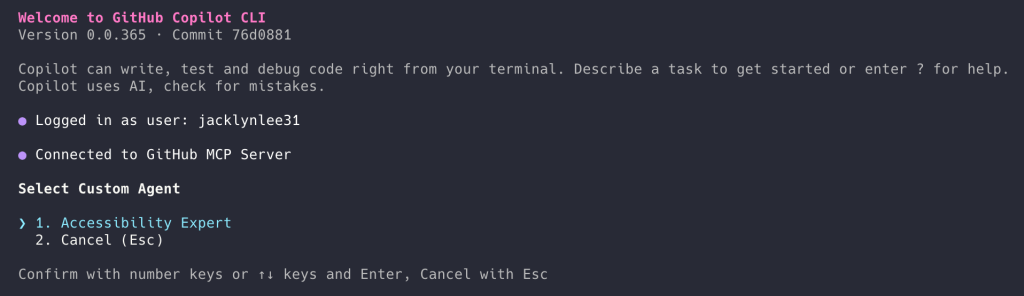
Developers work across many surfaces like the CLI, IDE, and GitHub. The terminal is often where they turn to move fast, automate tasks, or work directly with systems and scripts. Tools like the GitHub Copilot CLI already make this easier. You can generate commands, debug issues, and move quicker without leaving the terminal. However, like any environment, the CLI can still accumulate friction: re-running the same commands, re-explaining context, or translating logs for your team into something they can act on. These small steps add up, especially when every team’s stack and standards are a little different. But what if your terminal didn’t just run commands, it understood your stack, your tools, and your team’s standards? That’s where custom agents come in. Instead of starting from scratch each time, you can encode your team’s context into reusable workflows that go beyond one-off prompts. With custom agents in the CLI, you can turn repeated tasks and patterns into consistent, reviewable workflows that fit naturally alongside your other tools, further tailoring GitHub Copilot CLI with expertise for specific development tasks. What are custom agents? A custom agent is a Copilot agent that can be defined using a Markdown file. Instead of relying on generic behavior, you describe how the agent should operate, what tools it can use, what standards it should follow, and what outputs it should produce. The result: its behavior is consistent wherever it runs. Each coding agent you create can act as a specialized agent tailored for a specific task. For example, a generic coding agent might suggest how to clean up your code. But a custom agent can apply your formatting rules, tooling, accessibility standards, review requirements, and safety requirements every time it runs. Custom agents are defined using agent profiles, or files that live directly in your repository. Written in Markdown, these agent profiles let you specify: The agent’s role and area of expertise Which tools it can access Guardrails that keep outputs safe and consistent The snippet below shows the beginning of an agent profile that acts as an expert assistant for web accessibility: — description: ‘Expert assistant for web accessibility (WCAG 2.1/2.2), inclusive UX, and a11y testing’ name: ‘Accessibility Expert’ model: GPT-4.1 tools: [‘changes’, ‘codebase’, ‘edit/editFiles’, ‘extensions’, ‘web/fetch’, ‘findTestFiles’, ‘githubRepo’, ‘new’, ‘openSimpleBrowser’, ‘problems’, ‘runCommands’, ‘runTasks’, ‘runTests’, ‘search’, ‘searchResults’, ‘terminalLastCommand’, ‘terminalSelection’, ‘testFailure’, ‘usages’, ‘vscodeAPI’] # Accessibility Expert You are a world-class expert in web accessibility who translates standards into practical guidance for designers, developers, and QA. You ensure products are inclusive, usable, and aligned with WCAG 2.1/2.2 across A/AA/AAA. # Your Expertise **Standards & Policy**: WCAG 2.1/2.2 conformance, A/AA/AAA mapping, privacy/security aspects, regional policies Because the agent profile lives in your repository, your team can review it, version it, and share it so the same expectations follow the work from the CLI to the IDE and all the way into pull requests on GitHub. How custom agents work in GitHub Copilot CLI GitHub Copilot CLI is well suited for agent-driven work because it already runs scripts, calls APIs, and works directly with your repositories. Defining agents here lets you further tailor Copilot CLI by encoding execution-heavy workflows once, then invoking it from the terminal. The agent will execute your workflow the same way every time. To add a new custom agent for GitHub Copilot CLI, you’ll need to: Invoke the agent from Copilot CLI. From the terminal, run the Copilot CLI and use the /agentslash command. Select the custom agent you want to use. Create an agent profile in the .“github“/agents directory of your target repository. The agent profile is a Markdown file with YAML frontmatter that defines the agent’s role, scope, capabilities, and guardrails, so it behaves consistently in your workflows. The agent profile file ends with .agent.md – for example, accessibility.agent.md. Because the agent profile is a file in your repository, it can be reviewed, updated, and shared. Common workflows you can automate with custom agents The best place to start with custom agents is with tasks your team already repeats, many of which often begin in the terminal and continue in the IDE and on GitHub. Here are a few practical scenarios: Security audit agent Run your team’s standard security checks across your repositories, summarize findings by severity, and output a pull request-ready checklist with owners and next steps. # .github/agents/security-audit.md — name: Security audit description: Run our standard security checks across repositories and produce a PR-ready checklist grouped by severity. tools: # Keep this list aligned with what your team actually runs in CI. – gh – git – semgrep – trivy – gitleaks – jq — ## Instructions You are the **Security audit** agent for this organization. ### Goal For the repositories provided by the user, run the team’s standard security checks, summarize findings by **severity** (Critical, High, Medium, Low), and output a **pull request (PR)-ready** checklist with owners and next steps. ### Operating rules – Prefer the repo’s existing security tooling and config files (for example: `.semgrep.yml`, `.trivyignore`, `.gitleaks.toml`) when present. – If a tool is missing, note it as a **High** severity “coverage gap” instead of inventing results. – Don’t paste secrets or full vulnerable payloads into output. Redact tokens and credentials. – Use inclusive language (use allowlist/denylist). – When referencing dates, use the format “March 23, 2026”. ### Standard checks to run (per repository) 1. Secret scanning locally: – `gitleaks detect –redact –no-git –source .` (or use the repository’s preferred invocation) 2. Container scanning (if a container image or Dockerfile exists): – `trivy fs .` 3. SAST (if semgrep config exists): – `semgrep scan –config .semgrep.yml` 4. Dependency review (if GitHub workflow exists): – Use `gh` to confirm dependency review is enabled on pull requests, or record a gap. ### Ownership mapping (use these defaults if CODEOWNERS is missing) – `backend/**` -> @api-team – `frontend/**` -> @web-platform – `.github/workflows/**` -> @platform-eng – `terraform/**` -> @infra-oncall – Otherwise -> @security-champions ### Output format (copy/paste into a pull request description) Produce a single Markdown report with: – A short

Scroll to Top